Ross Krouse - UNT Geography Major
Doesn’t look like my mandala location has been mowed in quite some time now and the grasses are taking off, little to no human influence can be found since last week’s visit. I’m starting to enjoy the fact that the lawn crews have left this area alone, it feels as if it brings more life to the area. Maybe we need to start thinking this way in areas that we mow frequently like roadsides, it would be healthier to grow native species in those areas than to just keep them groomed and more “pleasurable to the eye”.
Today a dirt dauber’s nest in one of the post oak’s has caught my eye. The common name for this insect is a “Mud Dauber;” most people are afraid of these little guys because they resemble wasps or other stinging insects. They are meticulous in their practices; I spend some time observing the females as they leave the nest to retrieve dirt and continue to build their geometric nest with ease. It makes me wonder how these bugs know their jobs and just do what they need to do to survive with just instinct. Its mind boggling when you think of how many insects there are and how many jobs are getting done by each of them everyday around the globe.
Tuesday, April 21, 2015

Springtime Rush
Ross Krouse - UNT Geography Major
Times are changing in my mandala location. As soon as I walk up I can feel it radiating off of my area of observation. Too me it seems as if it’s a completely different place, with a whole new feeling of life and energy seeping out everywhere my eyes look. Exact opposite of when I started in January.
The first thing I noticed was the prevalence of insects in my mandala, from creepy crawlers to aerodynamic flyers and all sorts in between. In my area there is a garden of Texas native pollinating plants, and I think they are doing their jobs quite well judging by the level of bug activity. But you can tell some clean up of the mandala has been done by humans because it looks too “pretty” and “organized” not like it would look if it would be left alone after planting. The bugs are harsh but nothing like the marshes of south Louisiana, or anything like the Amazon. But to us at this location that we are used too it seems like a lot. Just like someone from the Caribbean might not think it’s so hot in Florida but someone from Wisconsin would think Florida is boiling.
The post oaks are taking off with the springtime rush; they have changed substantially. They look fresh and flourishing instead of dry and dormant. Just being in their presence gives me a feeling of being tiny and fragile. They look so powerful and majestic, and every time I glance their way I can’t help but think about what kind of crazy vast roots systems they must have to hold themselves up. The grass hasn’t been cut. I think it looks better this way and more natural.
I’m starting to think the insects find me more attractive than the pollinating species.
Sunday, April 19, 2015
Cattails Redux
Chris Buchanan - UNT Integrative Studies Major
I am sitting on the edge of the pond that lies at the center of my Mandala. It is halfway through the third week in April. The sun is out, the sky is blue and clear on this warm, spring afternoon. The turtles are active today, swimming around the pond energetically, as they search for food. Tiny Gambusia fish are everywhere, feeding on insects and other nutrients that are floating on the surface of the pond. The Gambusia fish are very small, “minnow-size,” but their bellies are quite large and round, nearly doubling their size. Gambusia fish are commonly referred to as mosquito fish because they feed on the larvae of mosquitos.
Directly in front of where I am sitting, a small cluster of cattail plants are sprouting out of the water, surrounded by a short protective fence. Cattails are commonly found, clustered together in small groups in up to 2 ft. of water, in marshes and other wetlands throughout most of the world. Cattails are a very invasive species and they reproduce by using the wind to spread their fluffy seeds, and rhizomes, across the environment. The rhizomes quickly produce new shoots that grow into thick stands. Cattails flower from May through July. Their tiny flowers do not have petals and they are arranged into densely packed, cylindrical, spikes. The spikes are separated into male and female sections. In the spring, the male spike will detach from the plant after it sheds its pollen. Beginning in early fall, the flower enlarges into the large cylindrical brown head that we so commonly use to identify the species. After this, the head pops open, allowing the wind, water, and the force of gravity to spread its’ seeds and begin the process all over again.
I am sitting on the edge of the pond that lies at the center of my Mandala. It is halfway through the third week in April. The sun is out, the sky is blue and clear on this warm, spring afternoon. The turtles are active today, swimming around the pond energetically, as they search for food. Tiny Gambusia fish are everywhere, feeding on insects and other nutrients that are floating on the surface of the pond. The Gambusia fish are very small, “minnow-size,” but their bellies are quite large and round, nearly doubling their size. Gambusia fish are commonly referred to as mosquito fish because they feed on the larvae of mosquitos.
 |
| Cattails on the pond; photo by author. |
Red Eared Sliders
Chris Buchanan - UNT Integrative Studies Major
I returned to my mandala for the first time since the cold winter days have given way to the warmer afternoons of spring. It is now April and a cool breeze welcomed me back as I sat down along the edge of the small concrete pond that lies at the center of my mandala. My goal was to observe the several small groups of cattails that inhabit the pond and apply some of the research that I conducted on the invasive species of water plants, when I was immediately distracted by multiple organisms swimming around the pond. They are red eared slider turtles. The first one that I observed was floating, motionless; gripping onto the metal fencing that surrounds, and protects, the group of cattails. I then spotted another, swimming away in the opposite direction of where I was sitting. Before this day, I hadn’t seen any turtles inhabiting the pond and immediately assumed that they must be far less active during the winter.
While pondering the whereabouts of the turtles during the winter, I observed a third red eared slider swimming directly towards me. When it reached the edge of the pond, and the foot high cement wall separating it from myself, the turtle began swimming back and forth along the edge. At first I assumed that the turtle was investigating my presence in the mandala, then remembered the fact that almost every afternoon that I walked past the small body of water, I saw dozens of grade school children around the pond on field trips. Upon remembering this fact, I realized that the turtle was most likely searching for food, hoping that I would toss it what was left of my lunch. I then decided to test this theory by sticking my finger down to the edge of the water, where the turtle continued to swim back and forth. At first, it was curious and investigated the strange object that was hanging a centimeter away from its face. The turtle quickly decided that my hand was either a direct threat to its survival, or a potentially valuable food source, and snapped its tiny green mouth in the direction of my finger. Knowing that this was a very likely possibility, I was alert, and managed to pull my finger back in time before the turtle clamped down on my index finger. The reaction of the turtle led me to believe that it had grown accustomed to recognizing human visitors in its habitat as potential providers of food.
I returned to my mandala for the first time since the cold winter days have given way to the warmer afternoons of spring. It is now April and a cool breeze welcomed me back as I sat down along the edge of the small concrete pond that lies at the center of my mandala. My goal was to observe the several small groups of cattails that inhabit the pond and apply some of the research that I conducted on the invasive species of water plants, when I was immediately distracted by multiple organisms swimming around the pond. They are red eared slider turtles. The first one that I observed was floating, motionless; gripping onto the metal fencing that surrounds, and protects, the group of cattails. I then spotted another, swimming away in the opposite direction of where I was sitting. Before this day, I hadn’t seen any turtles inhabiting the pond and immediately assumed that they must be far less active during the winter.
 |
| Red eared slider at EESAT by the author. |
Monday, April 13, 2015
Sprouts
Jacob Korte - UNT History Major
Most of the flower variety which was present last week is gone. The henbit is still here, as are the clovers, although they have lost their flowers. The trees, including the cottonwood, are much greener now, amazingly so considering it has only been a week since I was last here. Likewise the Mexican plums have lost their weird, spikey looking flowers and are now just green bushes in appearance. There are some small beginnings of plum fruit on the branches, but they are not close to the size they will be once they are fully matured. It is windy and just recently rained and I haven’t seen a single ant around, there are several roly-poly bugs crawling around the Mandala. On the ground at the base of the plums, green shoots/sprouts have appeared which have a leaf structure very similar to the plums. Most likely they are new plums that landed near the base of the parent plant. There is a bird in the cottonwood which has been singing the same song for about five minutes, with roughly 20 second gaps in between repeats. It reminded me of the meeting we had with Dr. Haskell earlier today, and I wonder if he could have told me what the bird was.
Most of the flower variety which was present last week is gone. The henbit is still here, as are the clovers, although they have lost their flowers. The trees, including the cottonwood, are much greener now, amazingly so considering it has only been a week since I was last here. Likewise the Mexican plums have lost their weird, spikey looking flowers and are now just green bushes in appearance. There are some small beginnings of plum fruit on the branches, but they are not close to the size they will be once they are fully matured. It is windy and just recently rained and I haven’t seen a single ant around, there are several roly-poly bugs crawling around the Mandala. On the ground at the base of the plums, green shoots/sprouts have appeared which have a leaf structure very similar to the plums. Most likely they are new plums that landed near the base of the parent plant. There is a bird in the cottonwood which has been singing the same song for about five minutes, with roughly 20 second gaps in between repeats. It reminded me of the meeting we had with Dr. Haskell earlier today, and I wonder if he could have told me what the bird was.
Megafauna Ghost
Skip Warren - UNT History Major
 Spring growth from ground hugging plants has now obscured the feet of Bison antiquus. Not a real one of course as the last of his kind died near the start of the Holocene here in North America. This example is a somewhat wobbly full size abstract sculpted in metal. Heavy. I couldn’t help but think he could be standing exactly where one walked 11,000 years ago. As I stand next to him (I assume it is a “him”) my head falls two feet short of his height at the shoulder. Just about the perfect proportion. The artist has elected to not include the horns for whatever reason. They normally would have had a span of between three to four feet and they were never shed.
Bison antiquus had two predecessors, Bison priscus and Bison latifrons. Bison priscus managed to migrate from the Russian Steppes over the Bering Land Bridge where a 36,000 year old example was found in Alaska. Bison latifrons has been found as far south as present day Kentucky. Latifrons was a cousin of Antiquus and their existence here in North America actually overlapped. Unlike their cousin, Latifron’s horn span could reach nearly eight feet. Both however could weigh up to 2400 pounds. Their habitat is thought to have been different with Latifrons preferring forested areas (browser) and Antiquus choosing the plains (grazer).
Most are familiar with theories of human predation as being responsible for megafauna extinction. It is much more likely that changing environmental conditions brought during the Holocene is the major culprit. For instance archaeologist Dave Meltzer, using mammoth as example, has suggested that due to the dangers brought about by hunting large game, Clovis people most likely brought down one mammoth in their hunting career and then talked about it the rest of their lives. What is just as interesting are studies done on Antiquus skeletons that suggest dwindling populations brought on inbreeding which caused deformities to develop in skulls, horns and teeth. Ancient animals including man have long shown evidence that tooth health directly affected longevity. Combined with various diseases, predation by large cats and bears, a challenging environment and man, Latifrons and Antiquus lost out in transmitting genes that survived, though their smaller modern cousins Bison bison are alive today.
Wild Plum Flowers
Jacob Korte - UNT History Major
It has been about a month since we were out in our Mandalas, and a lot has changed. It appears as though winter is finally gone and spring is now here. The Mexican plums and post oaks in and around my Mandala have greened up, or at least have started to, and a few of the plums have their white flowers. The flowers of the Mexican plum are very interesting looking, they have almost a spikey/prickly look to them, however they are soft to the touch and more fuzzy feeling than anything.
It has been about a month since we were out in our Mandalas, and a lot has changed. It appears as though winter is finally gone and spring is now here. The Mexican plums and post oaks in and around my Mandala have greened up, or at least have started to, and a few of the plums have their white flowers. The flowers of the Mexican plum are very interesting looking, they have almost a spikey/prickly look to them, however they are soft to the touch and more fuzzy feeling than anything.
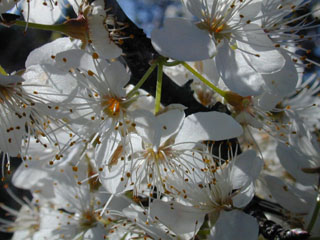 |
| Mexican plum flower: photo courtesy wildflower.org. |
Subscribe to:
Posts (Atom)