Sunday, April 19, 2015

Red Eared Sliders

Chris Buchanan - UNT Integrative Studies Major

I returned to my mandala for the first time since the cold winter days have given way to the warmer afternoons of spring. It is now April and a cool breeze welcomed me back as I sat down along the edge of the small concrete pond that lies at the center of my mandala. My goal was to observe the several small groups of cattails that inhabit the pond and apply some of the research that I conducted on the invasive species of water plants, when I was immediately distracted by multiple organisms swimming around the pond. They are red eared slider turtles. The first one that I observed was floating, motionless; gripping onto the metal fencing that surrounds, and protects, the group of cattails. I then spotted another, swimming away in the opposite direction of where I was sitting. Before this day, I hadn’t seen any turtles inhabiting the pond and immediately assumed that they must be far less active during the winter.

Red eared slider at EESAT by the author.
While pondering the whereabouts of the turtles during the winter, I observed a third red eared slider swimming directly towards me. When it reached the edge of the pond, and the foot high cement wall separating it from myself, the turtle began swimming back and forth along the edge. At first I assumed that the turtle was investigating my presence in the mandala, then remembered the fact that almost every afternoon that I walked past the small body of water, I saw dozens of grade school children around the pond on field trips. Upon remembering this fact, I realized that the turtle was most likely searching for food, hoping that I would toss it what was left of my lunch. I then decided to test this theory by sticking my finger down to the edge of the water, where the turtle continued to swim back and forth. At first, it was curious and investigated the strange object that was hanging a centimeter away from its face. The turtle quickly decided that my hand was either a direct threat to its survival, or a potentially valuable food source, and snapped its tiny green mouth in the direction of my finger. Knowing that this was a very likely possibility, I was alert, and managed to pull my finger back in time before the turtle clamped down on my index finger. The reaction of the turtle led me to believe that it had grown accustomed to recognizing human visitors in its habitat as potential providers of food.

Monday, April 13, 2015

Sprouts

Jacob Korte - UNT History Major

Most of the flower variety which was present last week is gone. The henbit is still here, as are the clovers, although they have lost their flowers. The trees, including the cottonwood, are much greener now, amazingly so considering it has only been a week since I was last here. Likewise the Mexican plums have lost their weird, spikey looking flowers and are now just green bushes in appearance. There are some small beginnings of plum fruit on the branches, but they are not close to the size they will be once they are fully matured. It is windy and just recently rained and I haven’t seen a single ant around, there are several roly-poly bugs crawling around the Mandala. On the ground at the base of the plums, green shoots/sprouts have appeared which have a leaf structure very similar to the plums. Most likely they are new plums that landed near the base of the parent plant. There is a bird in the cottonwood which has been singing the same song for about five minutes, with roughly 20 second gaps in between repeats. It reminded me of the meeting we had with Dr. Haskell earlier today, and I wonder if he could have told me what the bird was.

Megafauna Ghost

Skip Warren - UNT History Major
Spring growth from ground hugging plants has now obscured the feet of Bison antiquus. Not a real one of course as the last of his kind died near the start of the Holocene here in North America. This example is a somewhat wobbly full size abstract sculpted in metal. Heavy. I couldn’t help but think he could be standing exactly where one walked 11,000 years ago. As I stand next to him (I assume it is a “him”) my head falls two feet short of his height at the shoulder. Just about the perfect proportion. The artist has elected to not include the horns for whatever reason. They normally would have had a span of between three to four feet and they were never shed. 

Bison antiquus had two predecessors, Bison priscus and Bison latifrons. Bison priscus managed to migrate from the Russian Steppes over the Bering Land Bridge where a 36,000 year old example was found in Alaska. Bison latifrons has been found as far south as present day Kentucky. Latifrons was a cousin of Antiquus and their existence here in North America actually overlapped. Unlike their cousin, Latifron’s horn span could reach nearly eight feet. Both however could weigh up to 2400 pounds. Their habitat is thought to have been different with Latifrons preferring forested areas (browser) and Antiquus choosing the plains (grazer).

Most are familiar with theories of human predation as being responsible for megafauna extinction. It is much more likely that changing environmental conditions brought during the Holocene is the major culprit. For instance archaeologist Dave Meltzer, using mammoth as example, has suggested that due to the dangers brought about by hunting large game, Clovis people most likely brought down one mammoth in their hunting career and then talked about it the rest of their lives. What is just as interesting are studies done on Antiquus skeletons that suggest dwindling populations brought on inbreeding which caused deformities to develop in skulls, horns and teeth. Ancient animals including man have long shown evidence that tooth health directly affected longevity. Combined with various diseases, predation by large cats and bears, a challenging environment and man, Latifrons and Antiquus lost out in transmitting genes that survived, though their smaller modern cousins Bison bison are alive today.

Wild Plum Flowers


Jacob Korte - UNT History Major

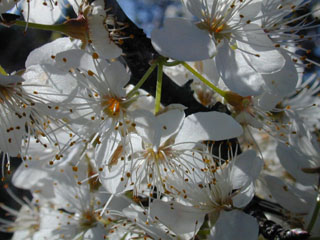
It has been about a month since we were out in our Mandalas, and a lot has changed. It appears as though winter is finally gone and spring is now here. The Mexican plums and post oaks in and around my Mandala have greened up, or at least have started to, and a few of the plums have their white flowers. The flowers of the Mexican plum are very interesting looking, they have almost a spikey/prickly look to them, however they are soft to the touch and more fuzzy feeling than anything.


http://www.wildflower.org/image_archive/320x240/JAM6151/6151_IMG00917.JPG
Mexican plum flower: photo courtesy wildflower.org.
There is also a new layer of underbrush in the beds bellow all the taller trees and plants, last time I was out here nothing green could be seen. Only the old cottonwood shows little progress and even then small leaves can be seen growing out of a few lower branches. There has also been a huge increase of wild flowers in my Mandala, henbits, clover along with some unidentified purple flowers. Also a very large dandelion which took me off guard, it has spikey leaves and the bulbs are also covered in pins. This cactus like appearance along with the size of the plant doesn’t remind me at all of the small, single stemmed dandelions that grew all over the yard at my parent’s house. I look forward to seeing how quickly things change now that spring has started.

The Roly Polies and The Bees

Kevin Hernandez - UNT Social Science Major

Not exactly the expression, I know. Today makes almost an entire month since I last visited my little spot, and time has really passed. Spring, evidenced by the already stifling Texas heat, has arrived. The Post Oak that shades my spot is actually providing shade now, it’s even began to pollinate. The dull orangish brown hanging “pods” contain seeds that disperse through the wind and I’m sure we’ve noticed the dust that has settled on all our cars. 

http://upload.wikimedia.org/wikipedia/commons/2/2b/Slater_rolled_up_for_wiki.jpg
A roly poly bug, photo from Wikipedia.org.


In the wood chips, I notice someone I haven’t seen until today, the roly poly. The woodlice family Armadillidiidae is usually called the pill bug or, more endearingly, the roly poly and is a land crustacean. Easily recognizable, this little guy can roll into a ball, a process called conglobation, when threatened, which makes sense with a name that sounds like the first half of “armadillo”. After unrolling they often have a hard time flipping over, like a turtle. 

Another new comer, this one more seasonal, also made an appearance. A bee. One bee is indicative of scouts trying to find viable pollen sources for the colony. Once located, the bee releases pheromones to tell the others it’s found food. This bee is most likely a European honey bee, one of the more common species to the Americas. The bee is a part of a large colony, just one of anywhere from 40,000 to 80,000. Behind it all, the ruler of the hivemind, is the queen. She can live as long as eight years pumping out 5,000 eggs a day. The male bees, the drones, are devoid of stingers and serve almost no other purpose than to fertilize these eggs. The Worker Bee, is the handywoman of the colony. They attend to young drones, the queen, the pollen, the honey, building the hive, and even the dead. Nearly one percent of the colony’s worker bees will die before a year is up. Honey bees are also excellent at thermoregulation, at least in their hive. There is a class in the hive known as the fanning bee that actually is tasked with regulating air flow in and out of the hive as well as cooling it with the use of water droplets. Interestingly, there is a species of honey bee commonly called the Japanese Honey Bee that is so effective at thermoregulation they can use it as a defense mechanism. The Japanese Giant Hornet, measuring a whopping two inches, can wreck a European Honey Bee hive but when faced with its Japanese relative, it often doesn’t stand a chance. The bees engulf the hornet and vibrate so quickly they raise the temperature as high as 115 degrees Fahrenheit effectively roasting the hornet alive. Unfortunately, there is a widespread collapse of colonies in European Honey Bees which is a very large issue. Their numbers are being reduced by parasites and disease and to lose such a prolific pollinator would be detrimental to Earth. Bees pollinate 70 of the 100 crops that feed 90% of the world, according to BBC. The grocery stores would have half the fruits and vegetables they have now. Without bees, we may lose the plants that feed the animals that feed us. The world would be a less green, less lively place.

Wednesday, April 1, 2015

Spring Has Sprung

Skip Warren - UNT History Major


In the two short weeks that has passed since my last observation, dramatic changes have taken place. The trees and bushes have exploded with buds and new leaves. One small tree thought dead this recently passed winter has produced groups of tightly bound clusters of buds at the tips of its branches. Flying insects are very busy. Bees, hornets and others so fast they cannot be identified. Doves and mockingbirds are competing to be heard. The low fern-like ground cover has grown 6-8 inches taller with longer stalks and denser foliage. It may be wild carrot or a similar looking poisonous hemlock. Both have similar looking tubers below ground. The few sprigs of dollar weed have also grown taller and sprouted short elongated purple flowers. The minnows have reappeared and are much more agitated. They must have been hiding under the ice during my last viewing. All sizes chase each other, breaching the surface occasionally as they swim the entire length of the pond. Not even the waterfall bothers them anymore. Spring’s warm weather has had dramatic effect on everything. Though not mentioned before, some trash that has been resident of the mandala for the last three months (and longer) is now home to various bug larvae swimming in collected rain water. A Styrofoam cup and a few creased food wrappers are habitats now. Paradoxically, picking up trash would now destroy life.

As mentioned before, the weather too is performing as advertised. The Marfa front out west has the potential to combine with an approaching cold front bringing a strong chance of severe weather tonight. Hail could really damage this small ecosystem. However this time, the mandala will be situated in the center of low pressure which might soften the blow. It is the northeast side of low pressure that always has the worst weather. As I write, the city of Tulsa, which lies northeast of the mandala, is getting hit with a tornado and strong thunderstorms from this same system, shutting down their airport. Consider what the northeast side of a hurricane is like.

The trash brings up a dilemma. Should I pick all of it up? No one has bothered as yet. I’m sure some of it has blown in through the fence just as sure as I am of people throwing some of it here. Some trash has been here quite a while as evidenced by its brittle, weathered nature. Corners of it peep out from old dense undergrowth. Maybe I should leave it all as midden to be discovered by some future archaeologist.

Marching Mandala

Ross Krouse - UNT Geography Major

Composed on March 11, 2015

The past few weeks the weather in our region hasn’t been too forgiving, we have had harsh winter conditions one day and then sunshine the next. Today’s weather to me seems like we are rounding the corner on our winter and headed to spring full steam. The sun is out, and after sitting here longer than ten minutes I’m starting to regret wearing jeans and not my shorts. And with the sunlight and heat, comes more noticeable life in my area. Plants are starting to pop up that I haven’t yet identified, that were definitely not noticeable on the first week of mandalas, hopefully after spring break I will have more time to examine these closer and identify the species. There are at least 16 more dandelions in my mandala area compared to last week’s 3. I notice more bug activity around me as well, mostly ants. I can’t identify the ant species exactly but I think they are black ants, whatever species of ant they are you can tell they are working tirelessly at a common goal. I’m excited for spring and the abundance of life the season brings with it.